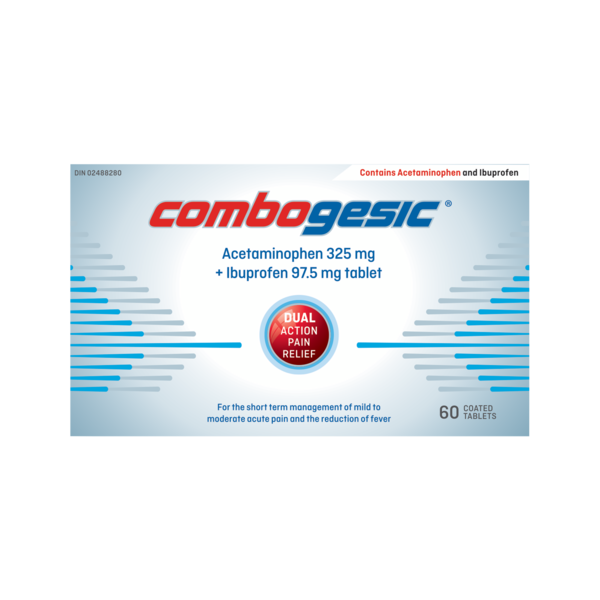
COMBOGESIC® (Acetaminophen/Ibuprofen) is indicated in adults over 18 years for the: • short term management of mild to moderate acute pain • reduction of fever
Pediatrics
Pediatrics (< 18 years): No data are available to Health Canada; therefore, Health Canada has not authorized an indication for pediatric use.
Geriatrics
Geriatrics (> 65 years of age): Evidence from clinical studies and experience suggests that use in the geriatric population is associated with differences in safety or effectiveness.
Contraindications
COMBOGESIC® is contraindicated in:
The peri-operative setting of coronary artery bypass graft surgery (CABG). Although COMBOGESIC® has NOT been studied in this patient population, a selective COX-2 inhibitor NSAID studied in such a setting has led to an increased incidence of cardiovascular/thromboembolic events, deep surgical infections and sternal wound complications.
The third trimester of pregnancy, because of risk of premature closure of the ductus arteriosus and prolonged parturition.
Patients with severe uncontrolled heart failure.
Patients with known hypersensitivity to acetaminophen, ibuprofen or to any of the components/excipients.
Patients with systemic lupus erythematosus, as an anaphylaxis-like reaction with fever may occur, particularly when ibuprofen has been administered previously.
Patients with a history of asthma, urticaria, or allergic-type reactions after taking ASA or other NSAIDs (i.e. complete or partial syndrome of ASA-intolerance – rhinosinusitis, urticaria/ angioedema, nasal polyps, asthma). Fatal anaphylactoid reactions have occurred in such individuals. Individuals with the above medical problems are at risk of a severe reaction even if they have taken NSAIDs in the past without any adverse reaction. The potential for cross-reactivity between different NSAIDs must be kept in mind.
Patients with active gastric/duodenal/peptic ulcer, active GI bleeding.
Patients with cerebrovascular bleeding or other bleeding disorders.
Patients with inflammatory bowel disease.
Patients with severe liver impairment or active liver disease.
Patients with severe renal impairment (creatinine clearance <30 mL/min or 0.5 mL/sec) or deteriorating renal disease (individuals with lesser degrees of renal impairment are at risk of deterioration of their renal function when prescribed NSAIDs and must be monitored).
Patients with known hyperkalemia.
Children and adolescents less than 18 years of age.
Patients with active alcoholism as chronic excessive alcohol ingestion may predispose patients to hepatotoxicity.
Patients with blood formation disturbances.
Dosage and Administration
Dosing Considerations – For oral administration and short term use only. – Do not take for fever for more than 3 days or pain for more than 5 days unless directed by a physician. – Do not take COMBOGESIC tablets with other acetaminophen or ibuprofen containing products. – Take with food or milk if stomach upset occurs. – Do not take more than 12 tablets per day.
Recommended Dose and Dosage Adjustment For the short-term management of mild to moderate acute pain and the reduction of fever, the recommended adult dose of COMBOGESIC® is 1-2 tablets every 6 hours. If pain or fever does not respond to 2 tablets, 3 tablets may be taken at subsequent doses, but only on the advice of a physician. Do not exceed 12 tablets over a 24-hour period. Pediatrics (< 18 years of age): Safety and effectiveness of COMBOGESIC® in pediatric and adolescent patients have not been established; therefore, Health Canada has not authorized an indication for pediatric use. Geriatrics (≥ 65 years of age): No adjustment in labelled dosage is necessary for older patients, who require acetaminophen therapy. Those who require therapy for longer than 3 days should consult their physician for condition monitoring; however, no reduction in recommended dosage is necessary. However, caution should be taken with regard to the use of ibuprofen as it should not be taken by adults over the age of 65 without consideration of co-morbidities and co-medications because of an increased risk of adverse effects, in particular heart failure, gastrointestinal ulceration and renal impairment.
Administration This product is recommended to be taken with a full glass of water.
Missed Dose If the patient forgets a dose, they should take it as soon as they remember. But if it is almost time for the next dose, they should not take the missed dose. Instead, they must take the next scheduled dose. The patient should not try to make up for the missed dose by taking a double dose next time.
Overdosage
COMBOGESIC® is a combination product. The clinical presentation of overdose may include the signs and symptoms of acetaminophen toxicity, ibuprofen toxicity, or both.
Symptoms Acetaminophen Liver injury and even failure can occur following acetaminophen overdose. Symptoms of acetaminophen overdose in the first 24 hours are pallor, nausea, vomiting, anorexia and abdominal pain. Liver damage may become apparent 12 to 48 hours after ingestion. Abnormalities of glucose metabolism and metabolic acidosis may occur. In severe poisoning, hepatic failure may proceed to encephalopathy, coma and death. Acute renal failure with acute tubular necrosis may develop in the absence of severe liver damage. Cardiac arrhythmias have been reported. Liver damage is possible in adults who have taken 10 g or more of acetaminophen, due to excess quantities of a toxic metabolite. Ibuprofen Symptoms include nausea, abdominal pain and vomiting, dizziness, convulsion and rarely, loss of consciousness. Clinical features of overdose with ibuprofen which may result are depression of the central nervous system and the respiratory system.
Treatment Acetaminophen: Prompt treatment is essential in the management of acetaminophen overdose even when there are no obvious symptoms, because of the risks of liver injury, which presents after some hours or even days delay. Medical treatment is advised, without delay in any patient who has ingested 7.5 g or more of acetaminophen in the preceding 4 hours. Gastric lavage should be considered. Specific therapy to reverse liver injury with an antidote such as acetylcysteine (intravenous) or methionine (oral) should be instituted as soon as possible.
Acetylcysteine is most effective when administered during the first 8 hours following ingestion of the overdose and the effect diminishes progressively between 8 and 16 hours. It used to be believed that starting treatment more than 15 hours after overdose was of no benefit and might possibly aggravate the risk of hepatic encephalopathy. However, late administration has now been shown to be safe, and studies of patients treated up to 36 hours after ingestion suggest that beneficial results may be obtained beyond 15 hours. Furthermore, administration of intravenous acetylcysteine to patients who have already developed fulminant hepatic failure has been shown to reduce morbidity and mortality.
An initial dose of 150 mg/kg of acetylcysteine in 200 mL 5% glucose is given intravenously over 15 minutes, followed by an I.V. infusion of 50 mg/kg in 500 mL 5% glucose over 4 hours and then 100 mg/kg in 1 litre 5% glucose over 16 hours. The volume of I.V. fluids should be modified for children.
Methionine is given orally as 2.5 g every 4 hours up to 10 g. Methionine treatment must be started within 10 hours after ingestion of acetaminophen; otherwise, it will be ineffective and may exacerbate liver damage.
Evidence of serious symptoms may not become apparent until 4 or 5 days following overdose and patients should be carefully observed for an extended period. Ibuprofen: Treatment should be symptomatic and supportive and include the maintenance of a clear airway and monitoring of cardiac and vital signs until stable. Gastric lavage is only recommended within 60 minutes after ingestion of a life-threatening dose. Because the drug is acidic and is excreted in the urine, it is theoretically beneficial to administer alkali and induce diuresis. In addition to supportive measures, the use of oral activated charcoal may help to reduce the absorption and reabsorption of ibuprofen tablets.
For management of a suspected drug overdose, contact your regional poison control centre or Health Canada’s toll-free number, 1-844 POISON-X (1-844-764-7669)
Dosage Forms, Strengths, Composition and Packaging
Route of Administration
Dosage Form / Strength/Composition
Non-medicinal Ingredients
Oral
Film coated tablets Acetaminophen 325 mg/ Ibuprofen 97.5 mg.
Description COMBOGESIC® tablets are white, biconvex, capsule shaped film coated tablets debossed with ‘C’ on one side and plain on other side, available in blister pack sizes of 30 and 60 tablets.
Storage, Stability and Disposal
Store in the original blister package in order to protect from light. Keep out of sight and reach of children. Store at room temperature (15 to 30°C).
Reporting Side Effects You can report any suspected side effects associated with the use of health products to Health Canada by:
Visiting the Web page on Adverse Reaction Reporting for information on how to report online, by mail or by fax; or
Calling toll-free at 1-866-234-2345.
NOTE: Contact your healthcare professional if you need information about how to manage your side effects. The Canada Vigilance Program does not provide medical advice.
If you want more information about COMBOGESIC®:
Talk to your healthcare professional.
Find the full product monograph that is prepared for healthcare professionals and includes this Patient Medication Information by visiting the Health Canada website (http://hc-sc.gc.ca/index-eng.php); the sponsor’s website www.aftpharm.com or by calling 1-855-611-2724.
This leaflet was prepared by AFT Pharmaceuticals (CAN) Ltd.
For the short-term management of mild to moderate acute pain and the reduction of fever, the recommended adult dose of COMBOGESIC® is 1-2 tablets every 6 hours.
If pain or fever does not respond to 2 tablets, 3 tablets may be taken at subsequent doses, but only on the advice of a physician.